Welcome to this interactive walkthrough
This project explores the relationship between cultural meaning and AI image generation through the case of Turkish coffee machine design.
Research framing
The study reproduces my design-research workflow and tests how AI systems interpret and recompose culturally loaded product cues.
Quick interaction demo
Select “Turkish”, “Coffee”, or both. The panel shows pre-generated outputs to make the semantic shift visible.
Observed bias
AI output shows a clear bias in how “Turkishness” is represented.
What changes when we apply this to coffee machines?
And which prompts are methodologically valid?
Prompt strategy for the coffee machine case
Prompts are divided into two groups: control prompts without cultural markers, and exploration prompts that explicitly include “Turkish”.
Electric Coffee Machine | Electric Turkish Coffee Machine
Incremental prompting
Keywords are introduced one by one through an incremental setup.
This makes each keyword’s effect on generated visuals measurable and comparable.
You can test the automation tool on the next slide.
Prompt Generator
From prompt lists to visual evaluation
Even six keywords produce many combinations very quickly.
Instead of reading lists, visual inspection makes patterns easier to detect.
You can toggle keywords interactively, as in the demo.
The baseline “coffee machine” term is fixed throughout the experiment.
Critical questions
Can AI tools mislead interpretation of design identity?
Can AI distort narratives around Turkish design culture and design history?
Why does this representational pattern persist?
My interpretation is that human and AI prioritize different semantic layers in the design process, which leads to diverging visual outcomes.
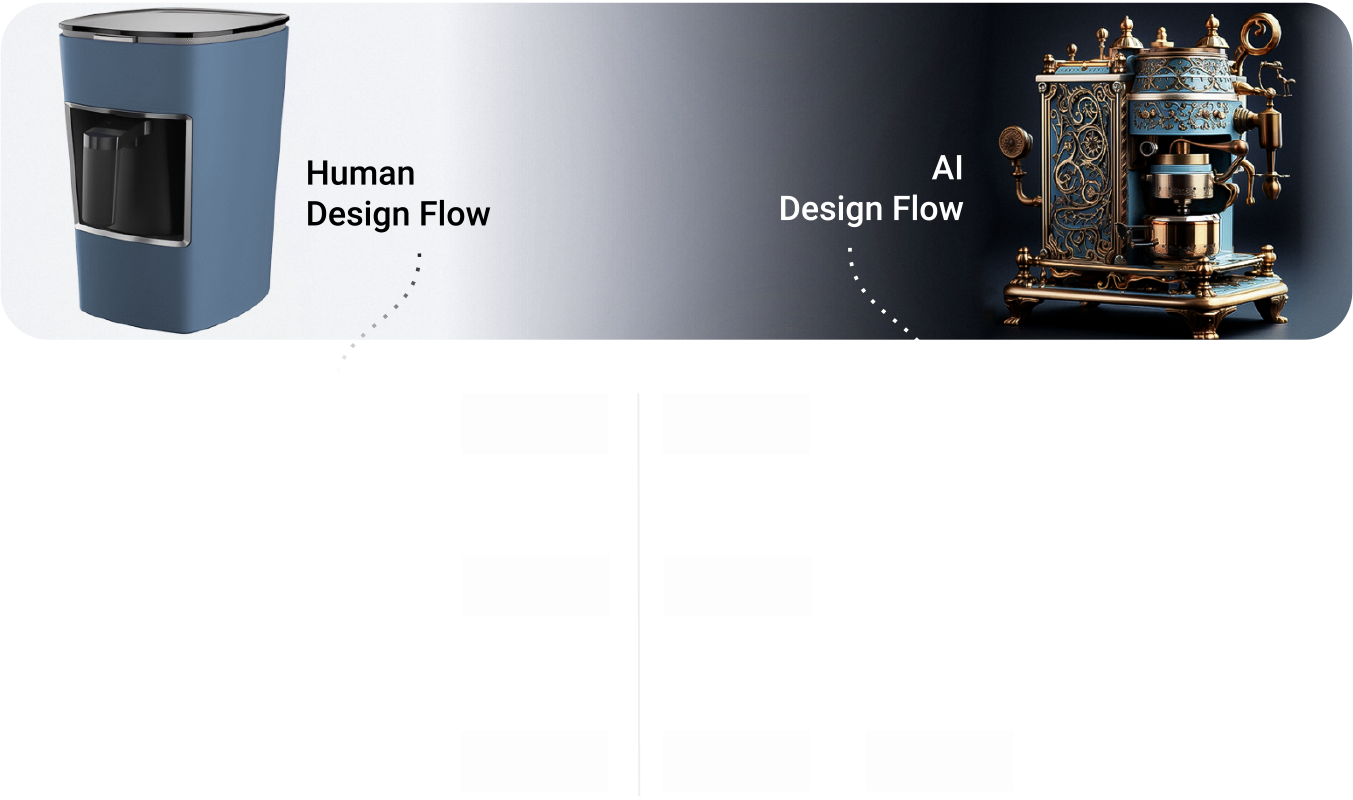
The difference is rooted in concept prioritization.
Human and AI systems weight cultural signals differently in object design.
This visualization is inspired by the study “How Artificial Intelligence Translates Design Culture of Everyday Objects: A Case Study of Turkish Coffee Machine” by Ulaş Tigin and Tuğba Tok.
The paper link will be added after publication. Thank you for joining this walkthrough.
© 2026 Ulaş Tigin